Press releases

Cancel
  • Optimization for the Battery Cycle

    Press Release / February 23, 2026

    Project ProB@tman
    © Project ProB@tman

    What will happen in the future to used batteries from electric vehicles? How can their valuable materials be recycled efficiently to create a genuine cycle for lithium-based batteries? With its research and development activities, the Fraunhofer R&D Center for Electromobility (FZEB) is conducting research and development into efficient and sustainable solutions for battery recycling in Germany. Now, another joint project by battery researchers and industry has been launched for the direct recycling of battery materials: ProBatman, which aims to optimize the process steps along the entire recycling process chain in terms of purity and yield.

    more info
  • Project "ReUse": Direct Battery Recycling
    © Fraunhofer ISC

    To reduce dependence on rising electricity prices, German households are in-creasingly turning to stationary battery storage systems combined with photo-voltaic systems. These systems provide solar energy around the clock, relieving the burden on power grids. But what happens in ten to fifteen years when these storage systems reach the end of their service life? The answer is direct recycling.

    more info
  • Conference on Battery Direct Recycling 2026
    © Fraunhofer ISC

    From February 3 to 5, 2026, the 2nd Conference on Battery Direct Recycling brought together international experts from research, industry, and politics at the Congress Centrum Würzburg. The event, organized for the second time by the Fraunhofer Institute for Silicate Research ISC, demonstrated how the field of research into the direct recycling of battery materials has developed in just one and a half years.

    more info
  • Logo HiQ-CARB

    Sustainable and high-quality conductive additives for lithium-ion batteries are one of the keys to e-mobility in Europe. In view of the increasing demand for rechargeable batteries due to the transition to electric vehicles and renewable energies, the development of innovative and environmentally friendly materials is of central importance. The HiQ-CARB joint project, funded by the European Union/EIT RawMaterials, has taken a major step forward in this key technology for reducing CO2 emissions over the last four years.

    more info
  • The "funky" side of solid-state battery development

    Press Release / March 18, 2025

    Project FUNCY-SSB Logo
    © Project FUNCY-SSB

    Solid-state batteries (SSBs) are considered the next generation of batteries com-pared to conventional Li-ion batteries. Despite significant research efforts, very few SSBs are market-ready. In recent years, various promising materials have been introduced, but one of the main challenges persists: the combination of these materials into a stable cell. The project consortium of FUNCY-SSB (pro-nounced "funky-ssb") with partners from Germany, Slovenia, and Norway aims to change this over the next three years.

    more info
  • Project IDcycLIB Logo
    © Project IDcycLIB

    After approximately three years, the battery project IDcycLIB, funded by the German Federal Ministry of Education and Research (BMBF) with around 7 million euros, has successfully concluded in December 2024. During the final project meeting at the Fraunhofer Institute for Silicate Research ISC in Würzburg, the outstanding results of the project were presented.

    more info
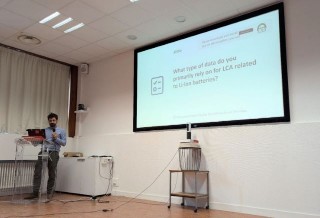
  • Antonio Valente from ecoinvent
    © HiQ-LCA/Fraunhofer ISC

    The HiQ-LCA project, funded by EIT RawMaterials and co-funded by the EU, supports the battery industry in complying with the EU Battery Regulation by offering various tools and services, including an advanced Life Cycle Assessment (LCA) database to be developed as a satellite database of the renowned ecoinvent database. To foster collaboration and encourage data contribution, project partner ecoinvent successfully organized industry workshops in 2023 and 2024, bringing together stakeholders to address key challenges and promote transparency. By contributing data, industry leaders gain access to peer-reviewed LCAs, compliance support, and an enhanced role in advancing sustainable battery production.

    more info
  • Project Rewind
    © Project Rewind

    Without lithium-ion batteries, environmentally friendly mobility and a sustain-able energy supply would be virtually inconceivable. However, the increasing demand for batteries and the associated raw materials poses major challenges. The REWIND project aims to overcome important obstacles on the way to an efficient and ecologically sustainable circular economy. REWIND is part of the BattFutur program of the German Federal Ministry of Education and Research (BMBF).

    more info
  • Project ReUse Logo
    © Project ReUse

    The ReUse project, short for "Efficient direct recycling for low-value LFP battery for circular and sustainable waste management," is a 36-month research initia-tive. It is funded by the European Union's Horizon Europe research and innova-tion program, operating under Grant Agreement No. 101137774, with a substan-tial EU contribution amounting to €4,927,664.93 in funding. The project com-menced in January 2024.

    more info
  • Project HiQ-CARB
    © Fraunhofer ISC

    For the future decrease of carbon footprints in electromobility, the production of traction batteries has to become “greener”. In improving the electronic conductivity of battery cathodes carbon plays a critical role and thus is essential to achieve fast charging and discharging rates. The HiQ-CARB project, funded by EIT RawMaterials under the Horizon Europe Program started in 2021 to make the supply with high-quality conductive additives more sustainable, with low carbon footprint and resource-efficient carbon materials. The results after the first half of the project leave no doubt that a switch to more sustainable manufacturing methods is possible.

    more info