 Fraunhofer R&D Center for Electromobility Bavaria
 Publications Fraunhofer R&D Center for Electromobility Bavaria
Recent Scientific Publications
Polymeric Electrochromic Materials
Chromogenics: Smart Switchable Optical Materials and Their Applications / 2025

As co-authors, Dr. Marco Schott and Dr. Uwe Posset wrote the chapter "Polymeric Electrochromics" for the book "Chromogenics: Smart Switchable Optical Materials and Their Applications":
Firsthand insights into the current and future technology and large-scale applications of color- and opacity-changing optical materials. Chromogenics delivers a comprehensive overview of the industry-relevant scientific background of chromogenics and provides details on successful manufacturing techniques for the scalable fabrication of products. The chapter "Polymeric Electrochromics" gives an overview of the most relevant research and developments towards industrial applications in the field of polymeric electrochromic materials.
Temperature-Dependent Voltage Control of Flexible Polymeric Electrochromic Devices for Improved Durability
Advanced Materials Technologies / 2025

The thermal stability of polymeric electrochromic devices (ECDs) on flexible substrates is crucial for most applications. In this study, the high-temperature cycling stability of the side-chain modified poly(3,4-ethylenedioxythiophene) (PEDOT-EthC6) and Prussian blue (PB) ECDs on indium tin oxide coated polyethylene terephthalate (PET-ITO) is investigated up to 60 °C. Without a temperature-dependent voltage control, a loss of optical contrast of 21% over 10 000 cycles at 60 °C and ±1.1 V is observed. Analysis of the cycled ECDs and cyclic voltammetry of the electrodes reveal that side reactions of the EC materials occur during cycling. A local aggregation state of the PEDOT-EthC6 is degraded. The PB electrode is overoxidized toward Prussian green as confirmed by UV-vis spectroscopy. Raman spectroscopy shows an altered doping state of the PEDOT-EthC6 electrode after cyclic voltammetry measurements up to 80 °C. The temperature-dependent onset potentials of the side reactions are determined. By cyclic voltammetry of ECDs with a Li reference electrode, safe voltage windows are established. With −0.55 V / +1.1 V, 91% of the initial contrast of τv = 10% ↔ 65% is retained over 10 000 cycles at 60 °C. The results demonstrate that an adaptation of switching parameters for temperature can improve the thermal stability of polymeric ECDs.
Combining broadband absorbing electrochromic materials for hybrid grey-to-colourless flexible devices
Chemical Communications / 2025

This study presents a grey-to-colourless hybrid electrochromic device combining a novel red-to-colourless polymer with blue-to-colourless Prussian blue. The device achieves a neutral tint in both the dark and bleached states, with notable changes in visible light transmittance and fast response.
Electrochemical Devices | Electrochromic Windows
Encyclopedia of Electrochemical Power Sources (Second Edition) / 2024
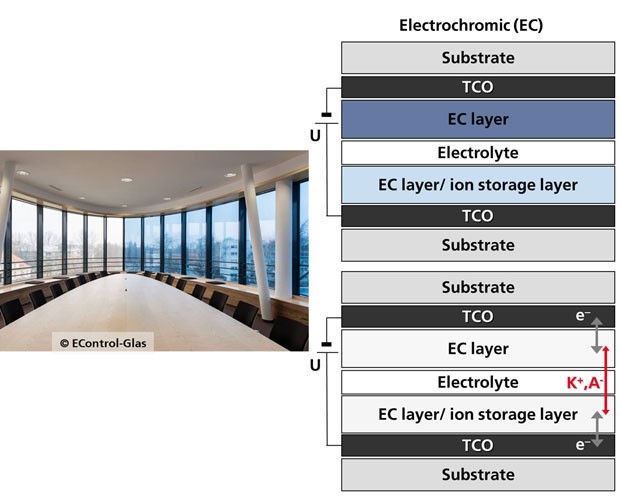
This chapter provides an overview of electrochromic (EC) glazing technologies available on the market or under development. EC systems for smart windows that are switchable between a colored and a colorless state or between different colored states by applying a low voltage or current can improve energy efficiency and comfort in buildings. Dynamic modulation in the visible (Vis) and near-infrared (NIR) regions of the electromagnetic spectrum enables an adaption of the thermal and optical behavior of a glazing system to ambient conditions. While the energy consumption for air conditioning and artificial lighting is significantly reduced, smart windows can continuously make optimal use of daylight and be tailored to personal needs using appropriate control algorithms.
Investigation of Acoustic Attenuation and Resonances in Lithium-Ion Batteries using Ultrasound Spectroscopy
Batteries & Supercaps / 2024
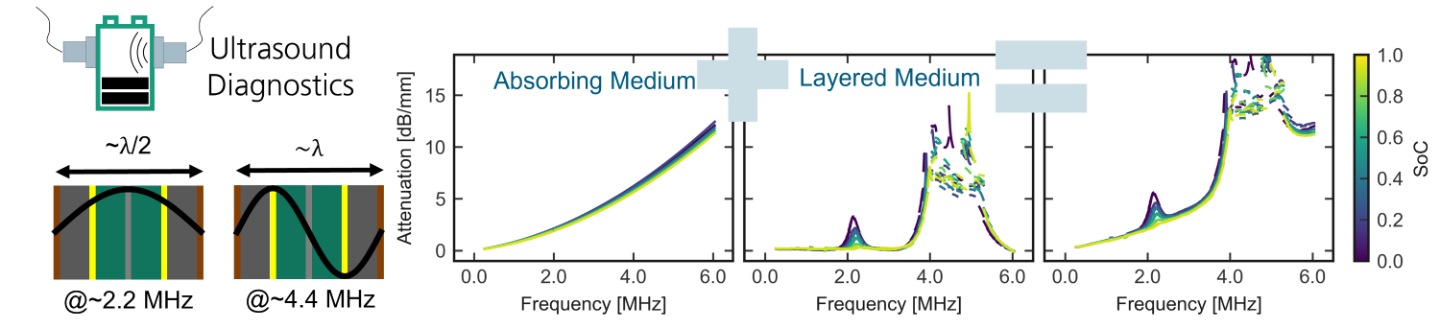
Ultrasound spectroscopy (up to 6 MHz) on a 12 Ah Lithium-ion cell reveals absorption and resonance components of attenuation. Two resonances are identified. The attenuation of the first resonance linearly decreases with state of charge. Matching interrogation frequency to this resonance yields a 5x signal amplitude increase across 0-100 % charge, potentially enabling robust state of charge determination.
Factors Impacting the Photostability of a Roll-to-Roll Processed PEDOT Derivative for Flexible Electrochromic Devices
Advanced Materials Technologies / 2024
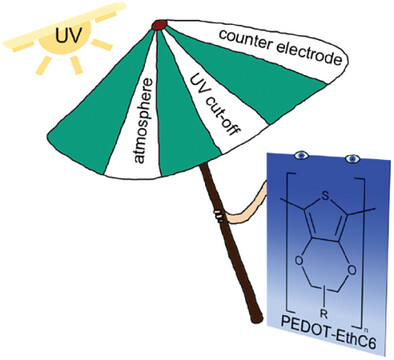
The photostability of roll-to-roll-processed, sidechain-modified poly(3,4-ethylenedioxythiophene) (PEDOT-EthC6) on indium tin oxide coated polyethylene terephthalate (PET-ITO) is improved by excluding ambient atmosphere. In the colored and bleached states, degradation is prevented by 420 and 500 nm long pass filters, respectively. Nickel oxide, as a counter electrode and UV protection, results in ECDs that show no loss of EC performance after 350 h of light exposure.
Electropolymerization of an EDOT-Quinoxaline Monomer for
Green Electrochromic Thin Films and Devices
Polymers / 2024
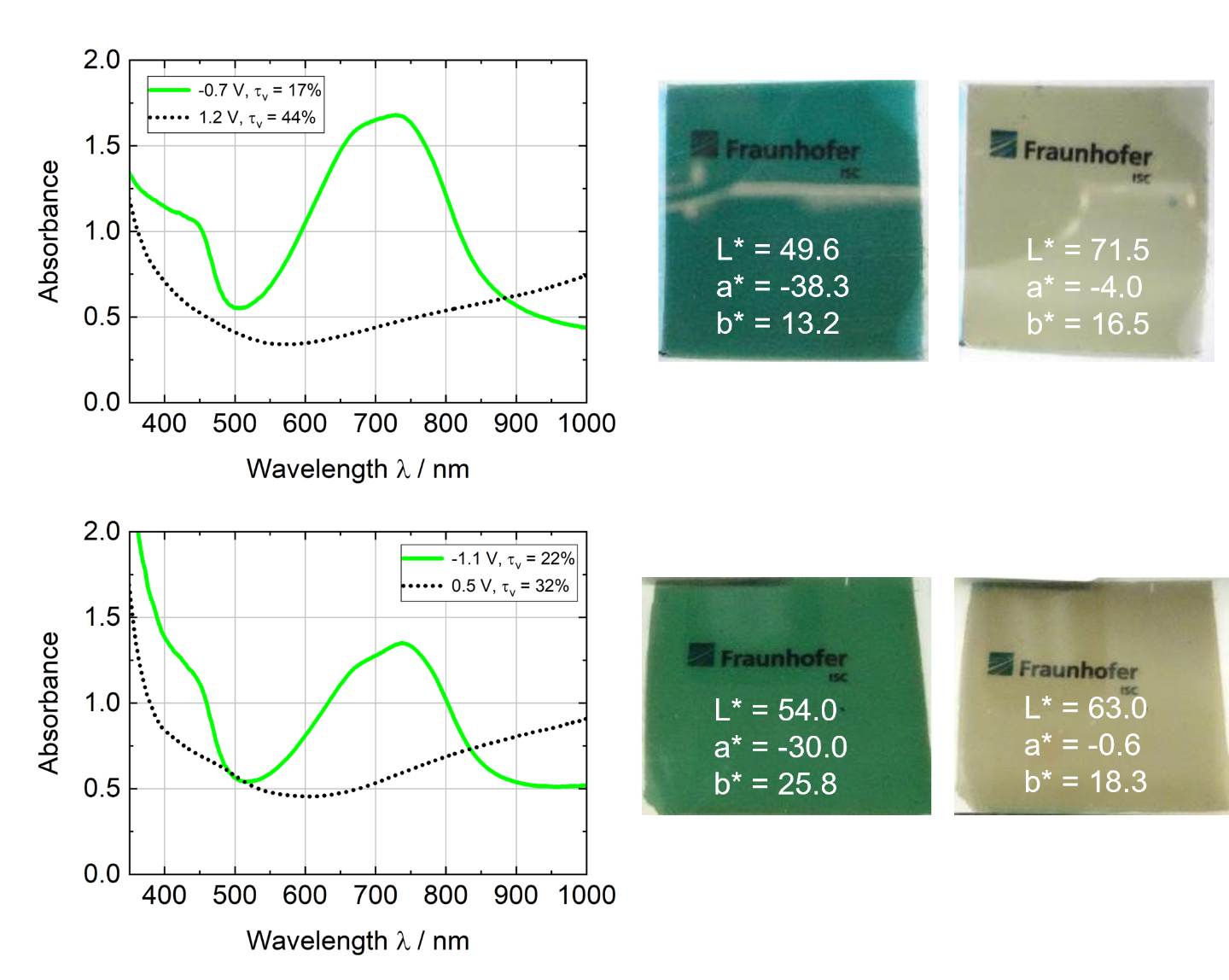
In this study, we present a 5,8-bis(3,4-ethylenedioxythiophene)quinoxaline monomer with two 4-(octyloxy)phenyl side chains (EDOTPQ) that can be electropolymerized on ITO glass in standard electrolytes containing lithium salts and propylene carbonate as solvent. The electrochemically deposited PEDOTPQ layers show very good adhesion and homogeneity on ITO. The green-colored polymer thin films exhibit promising electrochromic (EC) properties and are interesting for applications such as adaptive camouflage, as well as smart displays, labels, and sensors. Novel organic-inorganic (hybrid) EC cell configurations were realized with Prussian blue (PB) or titanium-vanadium oxide (TiVOx) as ion storage electrodes, showing a highly reversible and fast color change from green to light yellow.